
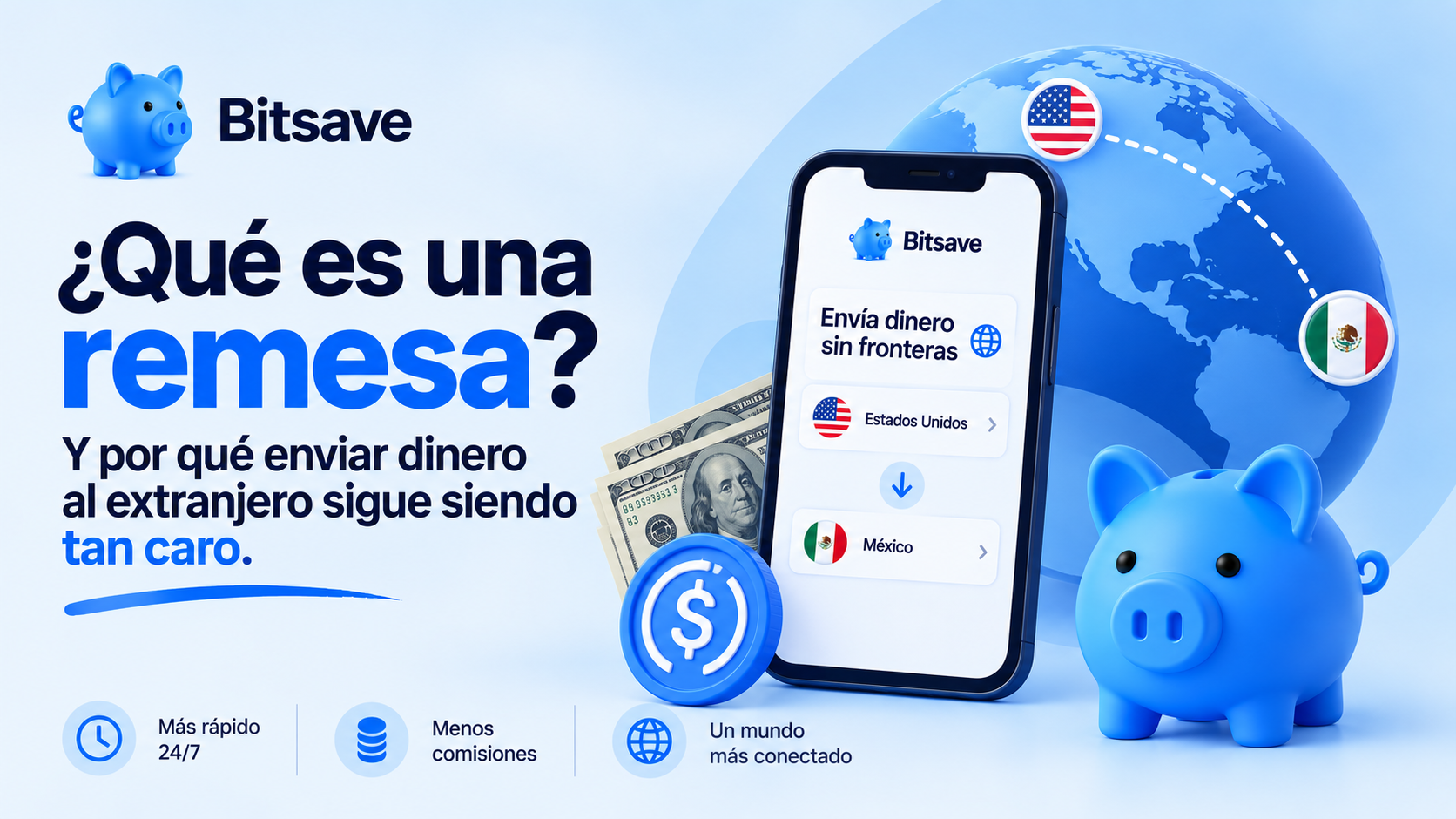
What is a remittance?
A remittance is simplymoney that a person living or working in another country sends to family or people in their home country.
For example:
A person works in the United States and every month he sends part of his salary to his family in Mexico.
That's a remittance.
And in Mexico they are enormous: during 2025 the country received approximately$62,472 million dollars in remittances.
How is a remittance traditionally sent?
There are different ways.
For example:
Banks.
Companies specialized in money transfer.
Electronic transfers.
Money orders.
Cash.
In fact, the vast majority of remittances that arrive in Mexico already move electronically. Of the approximately $62,472 million dollars received in 2025, around$61,893 million arrived through electronic transfers.
That is, money is already becoming digital.
So why can it cost so much to send money?
Because an international transfer does not always work like a transfer between two accounts in the same country.
There may be different costs along the way.
1. Commission for sending
The provider you use may charge a fee for making the transfer.
2. Exchange rate
This is one of the costs that sometimes goes unnoticed.
A company may offer you an exchange rate different from the reference exchange rate.
That means that even though the advertised commission may seem small, the person receiving the money could end up receiving less due to the currency conversion.
3. Intermediaries
Depending on the method used, an international transfer can involve different institutions before reaching the recipient.
And each step can add time or costs.
How much does it really cost to send a remittance?
It depends a lot on the country, provider, payment method and amount sent.
But the problem remains significant enough that the United Nations aims to reduce the average cost of international remittances to less than3% of the amount sent.
The World Bank even maintains a database dedicated to comparing the cost of shipping relatively small amounts across hundreds of international brokers.
That is why it is advisable to look not only at:
“How much commission do they charge me?”
But in:
“How much money does the other person really get?”
The other problem: time
Imagine that you need to send money urgently on a Saturday night.
Depending on the bank, country and system used, some transactions may not be processed immediately outside of certain hours or business days.
And here appears one of the big differences between traditional financial infrastructure and the new digital networks.
What changes with blockchain?
A blockchain is a digital network that allows assets to be transferred between wallets.
And one of its most important characteristics is thatthe network does not close.
Can operate:
24 hours a day.
7 days a week.
365 days a year.
It doesn't matter if it's Sunday, Christmas or midnight.
👉What does blockchain mean? Explained easily
Here digital dollars come in
Digital dollars, like stablecoins pegged to the US dollar, allow value to be represented and moved digitally.
Instead of thinking about a physical dollar bill, you can think about a digital version designed to hold a value close to that dollar.
And because these assets can be moved using blockchain, they open up new possibilities for international transfers.
👉What is a stablecoin and why do millions use it?
Imagine this example
A person lives in the United States and wants to send money to a family member in Mexico.
In the traditional model you might have to:
Dollars → remittance provider → conversion → pesos → recipient.
With infrastructure based on digital assets, it is possible to structure transfers in another way:
Digital dollars → blockchain → recipient's wallet.
Then, depending on the service used, the recipient can keep those digital dollars or convert them to their local currency.
Does it mean that sending via blockchain is always free?
No.
This is important.
Blockchains can also havenetwork commissions, and its cost depends on the network used and the conditions at the time.
Additionally, buying, selling or converting digital assets may involve other costs depending on the platform.
The advantage is not that all costs magically disappear.
The difference is that technology allowsrethink how money moves internationally, reducing in certain cases the number of intermediaries and allowing operations outside traditional banking hours.
Money is already changing
There is an interesting fact.
In 2025, Mexico will receive approximately158.6 million remittance operations, with an average amount close to$394 dollars per operation.
And almost all of those operations were already electronic.
The next change is not necessarily going from “cash to digital.”
That is already happening.
The next step may be to changethe infrastructure behind digital money.
What do digital dollars have to do with the future of remittances?
A lot.
Because they combine two important things:
The dollar, a currency widely used internationally.
and
Blockchain, an infrastructure designed to move digital assets globally.
This allows us to imagine international transfers:
Available 24/7
Digital from the beginning
Accessible from a cell phone
With operations monitoring
No need to carry cash
Will digital dollars replace traditional remittances?
Not necessarily.
Banks and remittance companies continue to play a vital role and, depending on the situation, may continue to be the best option.
But now there is additional infrastructure.
And that means more ways to move money around the world.
How does Bitsave come into all this?
Bitsave aims to make accessing and using digital assets easy.
From a single application you can manage digital dollars and other assets without needing to understand all the technology behind it.
The idea is simple:
Make using digital money feel as easy as using any other financial application.
👉Why are millions of people switching from physical money to digital money?
👉How a transfer with crypto works explained easily
👉How safe is it to save in digital dollars?
Conclusion
A remittance is much more than a transfer.
For millions of families it is money that crosses borders every month to pay for food, education, housing and daily expenses.
But moving money internationally can still involvecommissions, currency conversions, intermediaries and waiting times.
Blockchain and digital dollars do not automatically eliminate all of these problems, but they offer a new infrastructure for moving value globally.
Money has already become digital.
Now the way you travel from one country to another is also changing.
Sources
Banco de México — Remittance statistics 2025 and 2026.
World Bank — Remittance Prices Worldwide.
World Bank — Costs and 3% international target for remittances.