
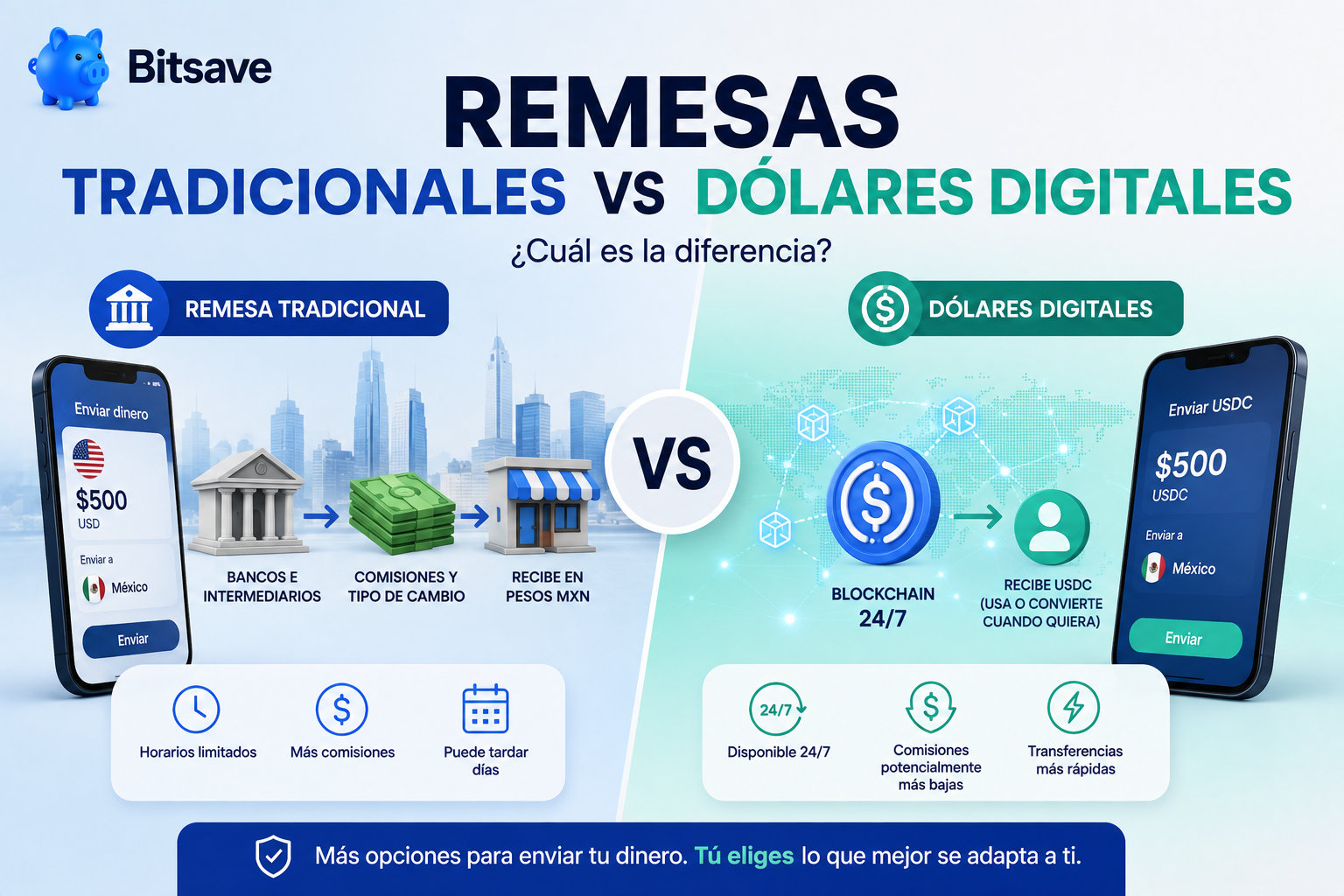
First: what is a remittance?
A remittance is money that a person sends to someone in another country.
For example:
A person works in the United States and sends part of his salary to his family in Mexico.
Traditionally, this money may pass through banks, money transfer companies or other intermediaries before reaching the recipient.
👉What is a remittance and why is sending money abroad still so expensive?
What is a traditional remittance?
Imagine that you want to send$500 USD from the United States to Mexico.
With a traditional service, something like this usually happens:
You → remittance provider → currency conversion → recipient
Depending on the service used, there may be:
shipping commission
conversion from dollars to pesos
exchange rate margin
intermediaries
processing times
That's why it's not enough to ask yourself:
“How much do they charge me for shipping?”
Also important:
“How much does the other person really get?”
And how do digital dollars work?
Digital dollars, like USDC, are digital assets designed to maintain a value close to the US dollar.
Instead of physically sending cash or relying exclusively on traditional banking systems, these assets can be transferred using supported blockchain networks.
The idea can look like this:
Digital dollars → blockchain → recipient
👉What is a stablecoin and why do millions use it?
Traditional remittances vs digital dollars
Traditional remittance | Digital dollars | |
|---|---|---|
How to travel | Banks or remittance providers | Blockchain networks |
Availability | Depends on the service | Blockchain operates 24/7 |
weekends | Some operations may be delayed | The network is still working |
Intermediaries | There may be several | Blockchain transfer can be more direct |
Commissions | They depend on the provider and exchange rate | They depend on the platform and network |
Currency received | Often local currency | The sent digital asset can be received |
Access | Bank, app, branch or establishment | Wallet or compatible app |
Difference 1: schedules
This is one of the most interesting differences.
Traditional financial systems can depend on banking hours, business days and internal processes.
Blockchains, on the other hand, work continuously.
Monday to Sunday. Day and night. Weekends and holidays.
That doesn't mean that any platform guarantees instant withdrawals or conversions 24 hours a day, but the blockchain infrastructure itself does not “shut down.”
Difference 2: the exchange rate
This part is very important.
Imagine that you send dollars to Mexico and the recipient wants to receive pesos.
The provider needs to convert:
USD → MXN
The exchange rate used can affect how much the other person ultimately receives.
That's why a transfer that announces a small commissionIt is not necessarily the cheapest.
It is always a good idea to review the final amount that the recipient will receive.
Difference 3: do you have to convert immediately to pesos?
With a traditional remittance, many times the objective is for the recipient to end up receiving Mexican pesos.
With digital dollars there is another possibility.
The person can receive an asset linked to the dollar and, depending on the platform used:
keep it in digital dollars or later convert it to local currency
This may be interesting for someone who does not want to immediately convert everything they receive.
Difference 4: the intermediaries
A traditional international transfer may involve different institutions to move and settle the money.
Blockchain allows digital assets to be transferred between compatible addresses using a global infrastructure.
This can simplify certain parts of the process.
Are digital dollars always cheaper?
Not necessarily.
It is important to say it clearly.
Using digital dollars can also involve:
platform commissions
purchase or conversion costs
blockchain fees
costs when converting back to local currency
Therefore the correct comparison is not:
“Which one do you say has the least commission?”
The question should be:
“After all the costs, how much does the other person end up getting?”
A simple example
Imagine that you want to send$500 USD.
Traditional option
You send $500 USD.
The provider applies its commission and exchange rate.
The other person receives the final equivalent in pesos.
Option with digital dollars
You buy the equivalent in digital dollars.
You transfer them over a compatible network.
The other person receives the digital assets and can decide to keep or convert them later.
In both cases there are costs and risks that must be reviewed before carrying out the operation.
So which is better?
It depends on what you need.
A traditional remittance may be convenient for someone who simply wants their family member to receive cash or pesos directly.
Digital dollars may be interesting for people looking for:
move value digitally
use infrastructure available 24/7
keep part of the money pegged to the dollar
send assets between countries
manage money from your cell phone
There is no perfect option for everyone.
Remittances are also evolving
For years, digitizing a remittance simply meant replacing a branch with an app.
Now something different is happening.
The infrastructure behind the transfer is also changing.
Blockchain and digital dollars allow new ways to move value between countries without relying exclusively on traditional systems.
👉Why are millions of people switching from physical money to digital money?
And what does Bitsave have to do with it?
Bitsave aims to make using digital assets easy, even if you're not a blockchain expert.
From a single application you can manage digital dollars and other assets available on the platform.
The technology behind it can be complex.
The user experience doesn't have to be.
👉How a transfer with crypto works explained easily
👉How safe is it to save in digital dollars?
Conclusion
Traditional remittances and digital dollars seek to solve a similar problem:
move money from one person to another, even when they are in different countries.
The difference is in the infrastructure used.
Traditional systems depend on banks, remittance providers and conversions between currencies.
Digital dollars allow blockchain to be used to move value globally and keep it linked to the dollar.
None eliminates all costs or risks.
But today people havemore options to decide how they want their money to cross a border.